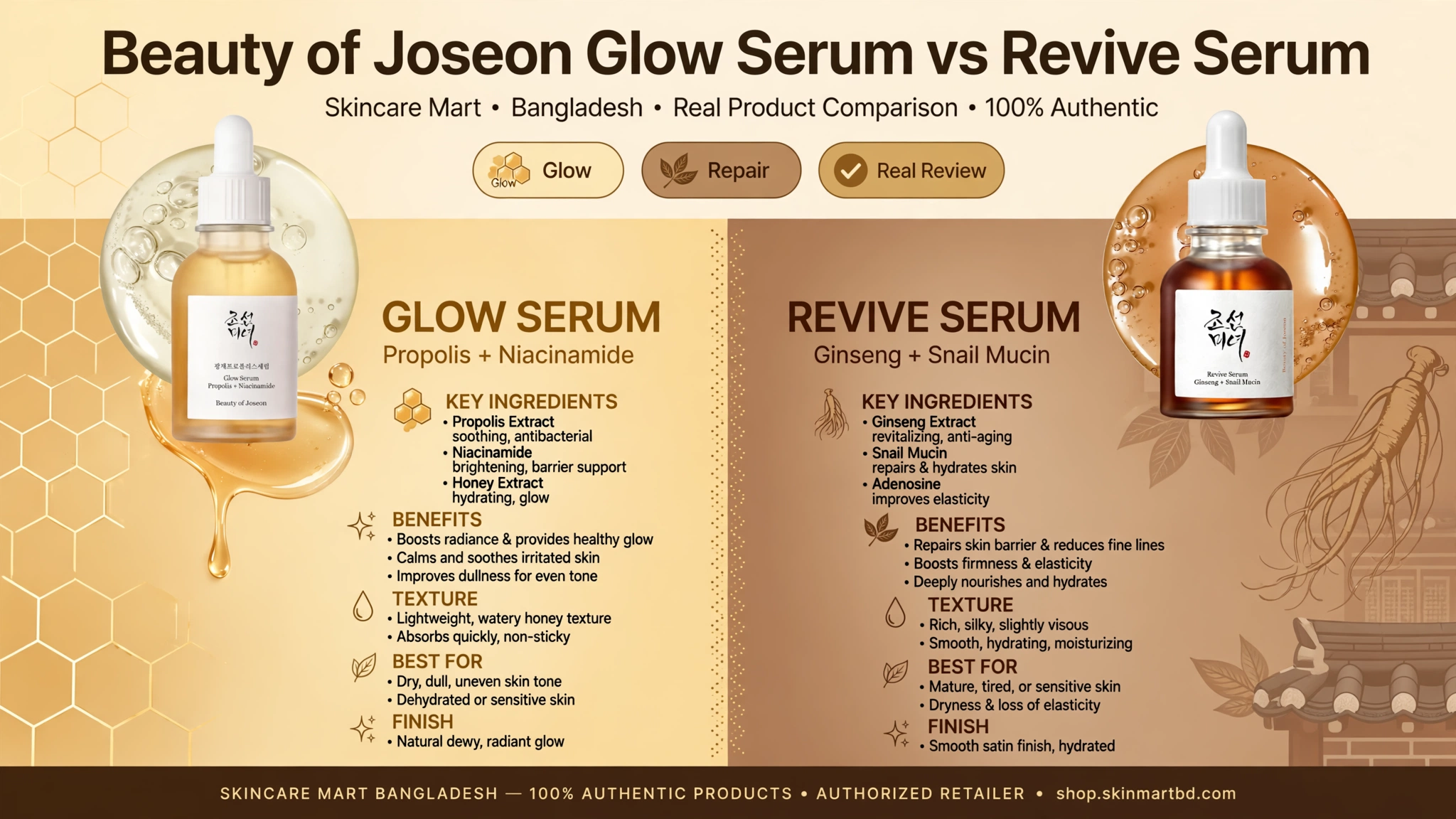
These two Beauty of Joseon serums are often shopped side by side because they share a brand, a similar bottle, and a "Hanbang" (traditional Korean herbal) story. They are not alternatives, though. One is a general face serum for glow and blemish-prone skin, and the other is a retinal serum made for the eye area, so choosing between them is really a question of which concern you have.
Quick answer: Glow Serum (60% propolis, 2% niacinamide) is a honey-like serum for dullness, oiliness, and blemish-prone skin, while Revive Eye Serum (10% ginseng root extract with retinal) is a beginner-friendly anti-aging serum for the eye area. Choose by concern, not by popularity, introduce only one at a time, and use sunscreen every day.
Who this comparison is for
This is for shoppers choosing between Beauty of Joseon's Glow Serum: Propolis + Niacinamide and Revive Eye Serum: Ginseng + Retinal. It is a formula-based comparison using published ingredient lists and brand descriptions, not hands-on testing, and it does not promise any result. Brand-reported clinical figures are marketing claims. If you have a diagnosed skin condition, a bee or honey allergy, or are pregnant or breastfeeding, check with a qualified clinician before using either product.
What Glow Serum: Propolis + Niacinamide is
The brand lists this serum as 60% propolis extract and 2% niacinamide, with 0.5% BHA (betaine salicylate) according to retailer descriptions, and notable plant ingredients including honey, tamanu oil, tea tree extract, turmeric, and centella. Retailers describe a honey-like texture, a pH of about 6.3, and a formula free of artificial fragrance, essential oils, alcohol, and silicone. The brand's suggested use is a few drops patted onto the face, morning and night, and it positions the serum for dullness, uneven tone, visible pores, and blemishes.
What Revive Eye Serum: Ginseng + Retinal is
This product's full name is Revive Eye Serum, so it is not a general face serum despite sometimes being listed as "Revive Serum". The brand lists 10% ginseng root extract and 2% retinal liposome, stated as an active content of 0.02%, along with niacinamide, glycerin, cholesterol, ceramide NP, and palmitoyl tripeptide-5. Retinal is a form of vitamin A, and retailers describe the formula as designed for retinal beginners and sensitive skin. The suggested use is one or two pumps after toner around the eyes, and one retailer says it can be used on the whole face. The brand reports four-week clinical results, which we have not independently verified, and retailers advise people who are pregnant or breastfeeding to avoid vitamin A products.
Side-by-side comparison
| Factor | Glow Serum: Propolis + Niacinamide | Revive Eye Serum: Ginseng + Retinal |
|---|---|---|
| Main purpose | Brightening, oil and pore appearance, blemish-prone skin | Fine lines and elasticity around the eyes |
| Headline ingredients | 60% propolis extract, 2% niacinamide, 0.5% BHA (per retailers) | 10% ginseng root extract, 2% retinal liposome (0.02% active), niacinamide |
| Active type | Mild exfoliant plus soothing and brightening ingredients | Vitamin A (retinal) |
| Usual timing | Morning and evening | Evening is the safer choice for a retinoid |
| Texture | Honey-like serum | Lightweight serum |
| Main cautions | Propolis and bee-product allergy, BHA sun sensitivity, plant oils on acne-prone skin | Pregnancy and breastfeeding, irritation around the eyes, sun sensitivity |
| Best suited for | Dull, oily, or blemish-prone skin | Visible fine lines and dryness around the eyes |
Which should you buy?
- Dullness, uneven tone, or blemish-prone skin: Glow Serum is the better match.
- Fine lines and crepey texture around the eyes: Revive Eye Serum is the one built for that.
- You are new to retinoids: Revive is marketed as beginner-friendly, but retinal is still a vitamin A product, so start slowly.
- You are pregnant or breastfeeding: skip Revive unless a clinician approves it, and ask about the Glow Serum's BHA as well.
- Tight budget: buy only the one that matches your concern, and put your first spending on sunscreen.
Cautions worth knowing
- Propolis can be an allergen. It is a bee product, and some people react to propolis or related bee and honey products, so patch-test the Glow Serum and avoid it if you have a known allergy.
- Glow Serum includes a BHA. Exfoliating acids increase sun sensitivity, so daily broad-spectrum SPF 30 or higher matters.
- Oils and extracts are not suited to everyone. Tamanu oil and several plant extracts are in the list, so breakout-prone skin should patch-test and watch for new bumps.
- Retinal needs a slow start. Begin a couple of nights a week, use a small amount, and keep it off the lid margins and near-eye edges at first.
- Do not stack everything at once. Using a BHA, a retinoid, and other actives in the same night raises the risk of irritation around sensitive eye skin.
- Stop if you see warning signs. Burning, swelling, persistent redness, or hives are reasons to stop and seek advice.
How to use them
- Patch-test each product separately, and allow time for a delayed reaction.
- Introduce one product at a time, and wait a couple of weeks before adding the other.
- Use Glow Serum after cleansing and toning, a few drops patted in, followed by moisturizer and, in the morning, sunscreen.
- Use Revive in the evening around the eyes, starting two nights a week and building up only if your skin stays comfortable.
- If you use both eventually, alternate nights at first instead of layering them together.
- Store both away from heat and sunlight, since retinoids and plant extracts are sensitive to storage.
Bangladesh climate context
Strong, year-round sun makes sunscreen non-negotiable with either serum, since both a BHA and a retinoid can increase sun sensitivity, and the American Academy of Dermatology recommends broad-spectrum SPF 30 or higher daily. Heat and humidity also raise oil and breakout risk in monsoon, according to a Dhaka dermatologist, which is when Glow Serum's target concerns tend to flare, but a honey-like texture can feel heavier in humid weather, so use only a few drops. Retinal is better kept in a cool, dark cupboard than on a sunny shelf or in a hot bag.
Mistakes to avoid
- Buying Revive for general glow. It is an eye serum for fine lines, not a brightening serum for the whole face.
- Skipping the patch test because the brand says "gentle". Propolis and retinal can both cause reactions.
- Using retinal every night from day one. Build up slowly.
- Forgetting sunscreen. Both serums make daily sun protection more important.
- Trusting a very cheap listing. Counterfeits are a documented problem in Bangladesh, so check the seller, batch code, and expiry date.
Frequently asked questions
Is "Revive Serum" a face serum?
The product is Revive Eye Serum: Ginseng + Retinal. It is designed for the eye area, although one retailer says it can be used on the whole face.
Is Glow Serum good for acne-prone skin?
The brand positions it for blemish-prone skin and includes a mild BHA, propolis, and tea tree. Patch-test, because the formula also contains oils and plant extracts that not every acne-prone skin tolerates.
Can I use both serums together?
Many people eventually use both, but introduce them separately. Use Glow Serum in the morning or evening and Revive in the evening, alternating nights at first.
Is retinal stronger than retinol?
Retinal is generally described as a more direct form of vitamin A than retinol, but the amount in this product is low, and the brand markets it as beginner-friendly. Strength still varies by person, so start slowly.
Are these serums safe in pregnancy?
We cannot say a product is safe for pregnancy. Retinal is a vitamin A product, so check with a qualified clinician before using Revive, and ask about the BHA in Glow Serum too.
Which should I buy first?
Whichever matches your main concern. For a first purchase, sunscreen, moisturizer, and cleanser still come before either serum.
Choosing by concern
Glow Serum is for the face and for glow and blemish concerns, while Revive Eye Serum is for lines around the eyes. Pick one, introduce it slowly, and protect your skin from the sun. Browse Skincare Mart and check each product page for the exact version, ingredient list, and batch and expiry details before you order.