The best sunscreen is not the one with the biggest number on the bottle. It is the one that protects properly, feels tolerable in Bangladesh's heat and humidity, and is comfortable enough that you reapply it. This guide walks through the label, the texture, and the habits that decide whether a sunscreen actually works for you.
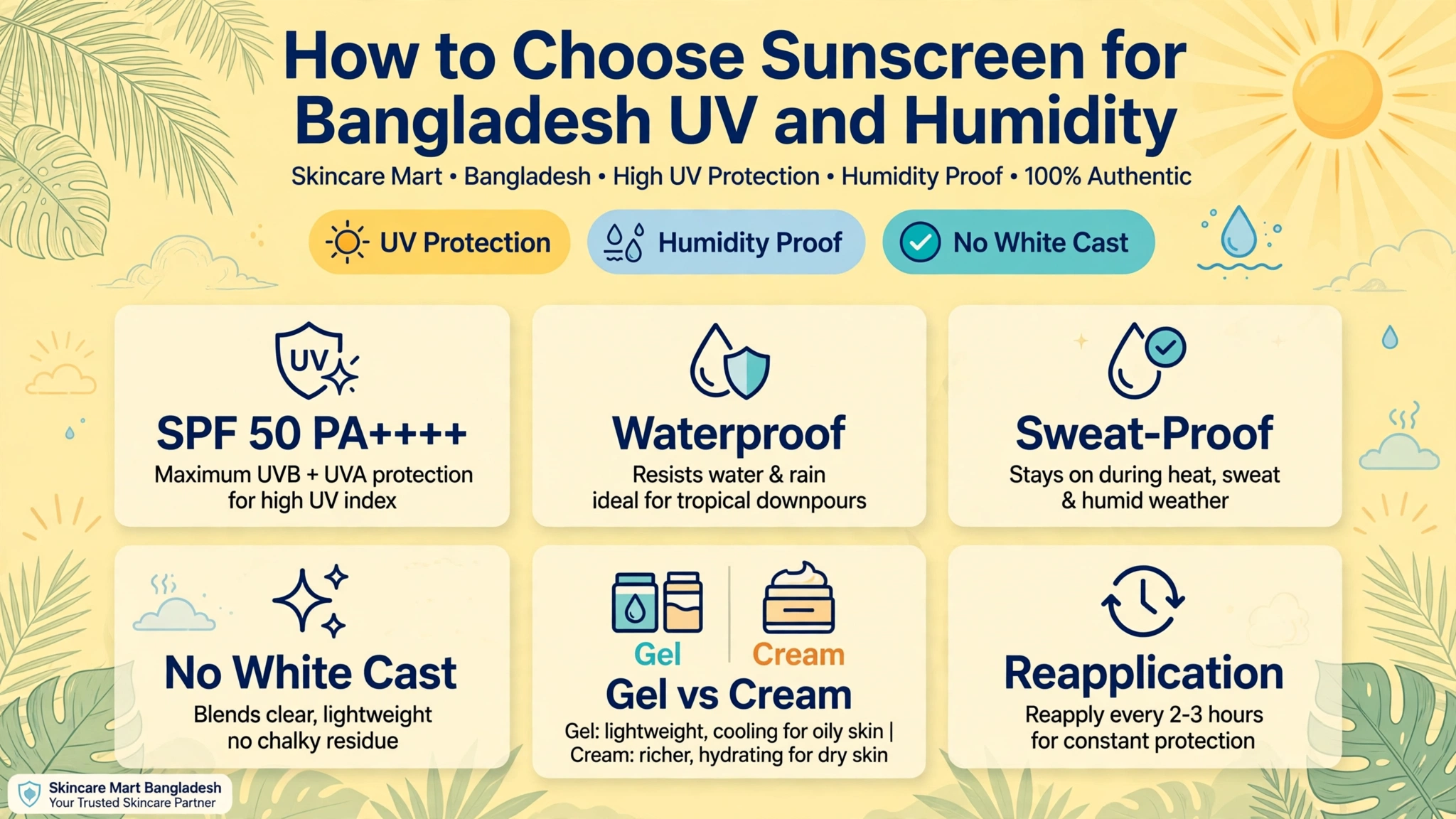
Quick answer: Choose a broad-spectrum sunscreen with SPF 30 or higher and a UVA mark such as PA+++, in a texture you will reapply through heat and sweat: gel or matte for oily skin, cream for dry skin. Apply at least a teaspoon to the face, reapply about every two hours outdoors, and check the expiry date and how the product has been stored.
Who this guide is for
This guide is for anyone choosing a daily facial sunscreen in Bangladesh, including Korean and Japanese sunscreens with PA ratings. It is general guidance, not a diagnosis. If you have a history of skin cancer, a photosensitive condition, melasma, or persistent irritation from sunscreens, ask a dermatologist to recommend a product. If you are pregnant or breastfeeding, ask a clinician about UV filters rather than relying on a label.
How strong is the sun in Bangladesh?
Weather2Travel's long-term climate averages (compiled from university and meteorological data) put Dhaka's typical monthly maximum UV index as follows:
| Months | Typical maximum UV index | Category |
|---|---|---|
| December to January | About 6 | High |
| February and November | About 7 to 8 | High to very high |
| March and October | About 9 to 10 | Very high |
| April to September | 11 or more | Extreme |
These are averages of the daily peak, and actual values change from day to day, so check a local forecast. The Daily Star has reported Dhaka's UV index averaging 11, rated "extreme", during an early heat wave, with forecasts as high as 12 at peak hours. The practical point is that even the lowest figure of the year is still in the "high" range, so sunscreen is a year-round product here.
What to check on the label
| Label item | What to look for | Why |
|---|---|---|
| Broad spectrum / UVA protection | The words "broad spectrum", a UVA mark, or a PA rating | Protects against both UVB (sunburn) and UVA (ageing and pigmentation) |
| SPF | SPF 30 or higher, as recommended by the American Academy of Dermatology | SPF 30 filters about 97 percent of UVB and SPF 50 about 98 percent, so applying enough matters more than a bigger number |
| PA rating | PA+++ or PA++++ on Korean and Japanese products | A UVA protection grade; a Dhaka dermatologist recommends PA+++ or higher |
| Water resistance | "Water resistant" for 40 or 80 minutes | No sunscreen is waterproof, so you still need to reapply |
| Expiry date and storage | A clear date, or a purchase date written on the pack | Dermatologists note people who get sunburned often used too little, did not reapply, or used expired sunscreen |
Choose a texture you will actually wear
| Your skin | Texture to try | Check |
|---|---|---|
| Oily or acne-prone | Gel, watery, or matte-finish, labeled oil-free or non-comedogenic | Avoid heavily fragranced or greasy formulas |
| Dry or dehydrated | Cream or lotion with a hydrating finish | The AAD notes creams and lotions suit dry skin and the face |
| Sensitive or reactive | Fragrance-free, simple formulas | Patch-test first and introduce it on its own |
| Prone to dark spots | A tinted sunscreen containing iron oxide | The AAD says tinted sunscreen with iron oxide better protects against dark spots |
| Touch-ups over makeup | A stick for small areas | Sprays make it hard to see how much you applied and should never be sprayed near the face |
Chemical, mineral, or hybrid?
Chemical (organic) filters absorb UV, mineral filters such as zinc oxide and titanium dioxide sit on the skin and block or scatter it, and hybrids combine both. All can protect well when applied properly. Choose by comfort, finish, and sensitivity: mineral formulas can leave more of a cast and feel heavier in humidity, while some people with sensitive skin prefer them. Check the ingredient list for fragrance if your skin is reactive.
How much to apply, and when
- Amount: The AAD says to use at least 1 teaspoon for the face, about the length of your index and middle fingers, and to rub it in thoroughly. Most people apply too little.
- Timing: Apply 15 to 30 minutes before going outside, as the last step of your morning routine.
- Reapplication: Reapply about every two hours outdoors and straight after sweating, even with water-resistant products.
- Lips and the rest of you: Use a lip balm with SPF 30 or higher, and cover the neck, ears, and any other exposed skin.
- Shade and clothing: Use them alongside sunscreen, since no sunscreen blocks everything.
Bangladesh climate context
Three local realities shape the choice. First, sweat and humidity break down a morning application quickly, so a lighter texture you are willing to reapply beats a heavy one you avoid. Second, clouds do not protect you: Dr Sifat Saba told The Daily Star that around 80 percent of UV still reaches skin through clouds, and recommended broad-spectrum SPF 30 or higher with PA+++ even on monsoon days and near windows. Third, heat damages products, so keep sunscreen out of hot bags, vehicles, and sunny windowsills, and replace it if it changes in smell, color, or texture.
Be careful about counterfeits
Sunscreen is a product where a fake is more than a waste of money. Which? quoted a dermatologist, Dr Aamna Adel, noting that counterfeit sunscreen may be sold with no testing of the protection it offers, and may give no protection at all. Buy from a seller who can explain their sourcing, check batch and expiry details, and be cautious about prices far below other sellers.
Examples to help you apply this
Earlier in this series we compared two Korean sunscreens. Beauty of Joseon's Relief Sun: Rice + Probiotics is listed as SPF50+ PA++++, fragrance-free, with organic filters, and a dewy finish. COSRX's Aloe Soothing Sun Cream is listed as SPF50+ PA+++, with a hybrid filter system and added fragrance. These are examples of how labels differ, not recommendations for every skin, so check each product page for current ingredients and stock.
Mistakes to avoid
- Applying too little. A thin layer gives less protection than the label suggests.
- Applying once and forgetting. Sweat and rubbing shorten protection, and reapplication matters.
- Choosing by SPF alone. Check for broad-spectrum or a PA rating too.
- Skipping it on cloudy, monsoon, or winter days. UV is still present.
- Using an expired or heat-damaged tube. Replace it if you cannot confirm its age.
- Relying on makeup with SPF. Cosmetics rarely get applied in the amount needed for the stated protection.
Frequently asked questions
Is SPF 50 much better than SPF 30?
Only slightly in laboratory terms: SPF 30 filters about 97 percent of UVB and SPF 50 about 98 percent. Applying enough and reapplying matter more than the number.
What does PA+++ mean?
It is a UVA protection grade used on many Korean and Japanese sunscreens, with more plus signs meaning higher UVA protection. Look for it alongside "broad spectrum" and an SPF of at least 30.
Which texture is best for humid weather?
Gel, watery, or matte textures often feel more comfortable and are easier to reapply, especially on oily skin. If your skin is dry, a cream or lotion may suit you better.
How much sunscreen should I put on my face?
The AAD recommends at least 1 teaspoon for the face, rubbed in thoroughly, and reapplying about every two hours outdoors.
Do I need sunscreen indoors?
If you are near windows or screens for long periods, a Dhaka dermatologist advises you still need protection. If you stay deep inside, it matters less, but most people go outdoors at some point during the day.
Is a particular sunscreen safe during pregnancy?
We cannot say a product is safe for pregnancy. Ask a qualified clinician about the specific UV filters and ingredients in the product you are considering.
Choosing with confidence
Pick a broad-spectrum sunscreen with SPF 30 or higher and a UVA mark, choose the texture you will wear and reapply, apply enough, and store it well. Browse Skincare Mart and check each sunscreen's product page for ingredients, SPF and PA details, and batch and expiry information before you order.