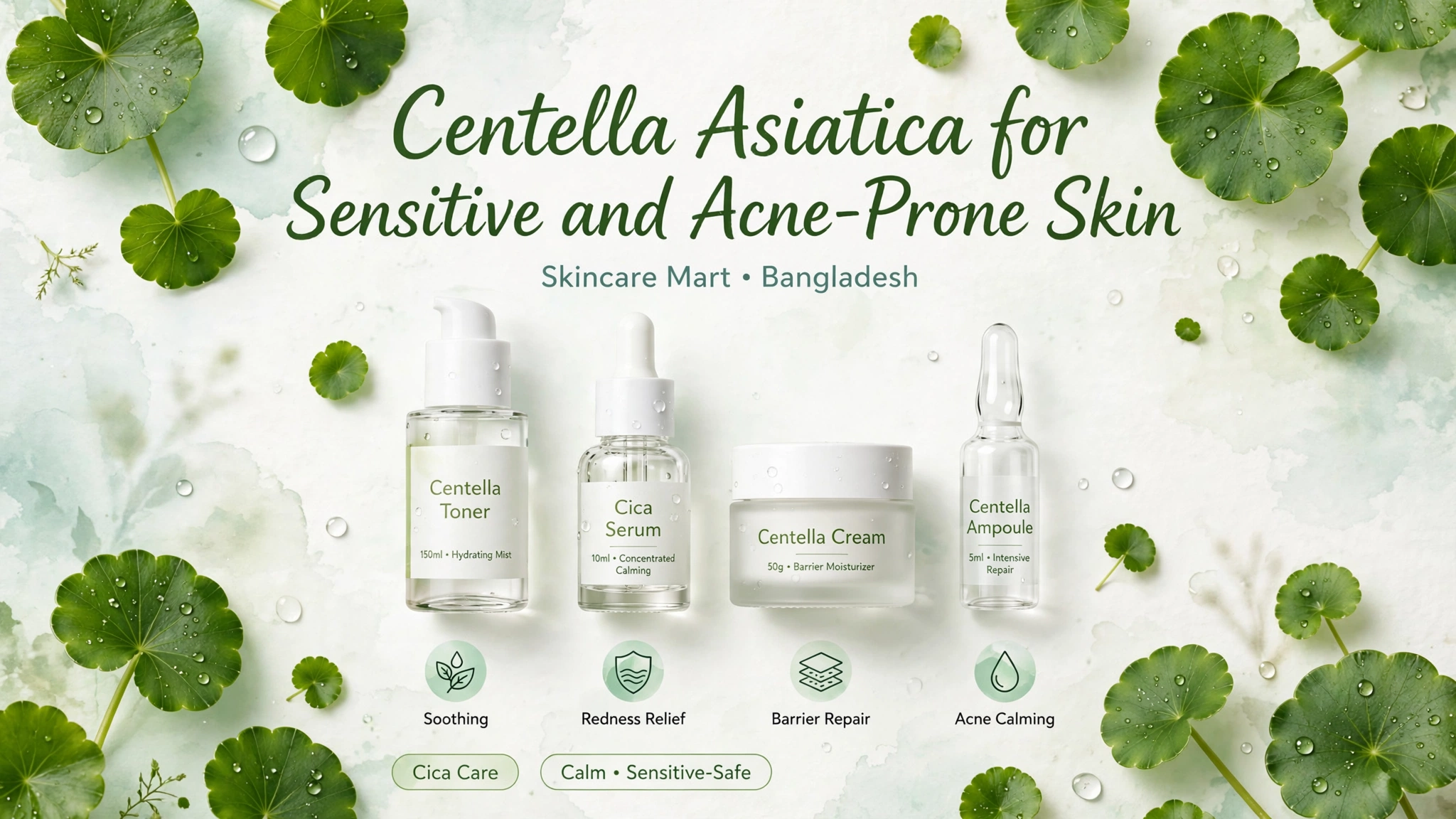
If your skin reacts to almost everything — a new cleanser, a bit too much sun, a stronger active you tried too soon — centella asiatica is usually one of the first ingredients dermatologists point to for calming things back down. Known across K-beauty as "cica," it's become one of the most reliably gentle actives in the category, and unlike a lot of trending ingredients, it has a reasonable amount of actual research behind it.
Quick answer: Centella asiatica (cica) is a calming, barrier-supporting botanical ingredient well-suited to sensitive, reactive, and acne-prone skin. Its four key active compounds — asiaticoside, madecassoside, asiatic acid, and madecassic acid — have been studied for anti-inflammatory, antioxidant, and wound-healing effects, including reducing the inflammation associated with acne. It's considered supportive rather than a primary acne treatment on its own, and is frequently paired with other actives (like retinoids or exfoliating acids) specifically to offset their irritation.
Who this guide is for
This is for people with sensitive, reactive, rosacea-prone, or acne-prone skin considering centella asiatica, or already using a "cica" product and wanting to understand what it's doing. This isn't a claim that centella cures acne, rosacea, eczema, or any other diagnosed skin condition — dermatologists describe the research as promising but still developing in places, and it works best as a supportive ingredient rather than a stand-alone treatment. If you have a diagnosed skin condition or persistent irritation, a dermatologist can advise on how centella fits alongside your existing treatment.
What centella asiatica actually is
Centella asiatica — also labeled cica, gotu kola, tiger grass, or Indian pennywort — is a plant used for centuries in Ayurvedic and traditional Chinese medicine for wound healing and skin repair. Its skincare relevance comes from four active compounds: asiaticoside, madecassoside, asiatic acid, and madecassic acid. Research has linked asiatic acid and madecassic acid to anti-inflammatory effects, while asiaticoside and madecassoside are associated with stimulating collagen synthesis and supporting wound healing.
What it does for sensitive skin
- Reduces redness and inflammation: Its anti-inflammatory compounds help calm skin that's reactive, flushed, or irritated — a large part of why it's so commonly recommended for rosacea-prone and generally sensitive skin.
- Supports the skin barrier: Studies suggest centella helps the skin barrier retain moisture and reduces trans-epidermal water loss, which matters for skin that's easily stressed by temperature swings or other actives.
- Helps skin recover from irritation: Because of its wound-healing properties, centella is often recommended after in-office procedures or alongside at-home use of retinoids or exfoliating acids, specifically to help offset the irritation those actives can cause.
What it does for acne-prone skin
Research on madecassoside, one of centella's key compounds, has shown it can reduce inflammation linked to acne-causing bacteria in laboratory studies, supporting its use for calming active breakouts. Dermatologists describe centella as helpful for the redness and inflammation that come with acne, and as potentially supportive for the appearance of marks left behind afterward — but it's consistently described as a supportive, calming ingredient rather than a primary acne treatment. For active breakouts, ingredients with stronger direct evidence — salicylic acid, benzoyl peroxide, adapalene — remain the first-line approach; centella works well layered alongside them to reduce the irritation those stronger actives can cause.
Bangladesh climate context
Centella's calming, barrier-supporting properties are particularly useful in Bangladesh's climate for two reasons. First, heat and humidity drive up sebaceous activity and breakout risk for much of the year, and a Dhaka dermatologist has noted this intensifies during monsoon season — a period where skin often needs extra calming support alongside acne treatment. Second, centella is specifically recommended for skin stressed by temperature or humidity swings, which makes it a reasonable year-round addition for skin that reacts to Bangladesh's shift between hot, humid months and the drier winter season.
How to read a centella product label
| What to look for | What it tells you |
|---|---|
| "Centella asiatica extract," "madecassoside," "asiaticoside," or "asiatic acid" | Any of these indicates the active compound family is present |
| Position in the ingredient list | Concentration and formulation matter more than the word "cica" on the front label — a well-formulated product with centella lower on the list can outperform a poorly stabilized one leading with it |
| Paired ingredients (ceramides, ceramide-ceramide complexes, panthenol) | Common, complementary additions for barrier repair and additional soothing |
How to introduce centella into a routine
Centella is one of the better-tolerated K-beauty actives and generally doesn't require the cautious, gradual introduction that stronger actives like retinoids or acids need — it's frequently used precisely because it's calming rather than irritating. That said, patch-testing any new product for 24 to 48 hours is still a reasonable habit, particularly if you have very reactive skin. It layers well under moisturizer and alongside most other skincare ingredients, and is commonly used both morning and night.
Mistakes and cautions
- Expecting centella to replace acne treatment. It's supportive, not first-line — active breakouts generally still need an ingredient like salicylic acid, benzoyl peroxide, or a retinoid alongside it.
- Buying based on the word "cica" alone. A product's position of centella in the ingredient list and overall formulation matter more than front-label marketing.
- Assuming all cica products are equally soothing. Some "cica" products include other ingredients (fragrance, alcohol) that can offset the calming effect for very reactive skin — check the full list, not just the headline ingredient.
- Overstating the anti-aging evidence. Some research points to benefits for photoaging and scar appearance, but dermatologists note more study is needed before making strong claims in that area.
Frequently asked questions
Is centella asiatica the same as cica?
Yes — "cica" is simply the K-beauty shorthand for centella asiatica, also sometimes labeled gotu kola or tiger grass.
Can centella asiatica clear acne on its own?
Not reliably. It helps calm the redness and inflammation associated with breakouts and can support skin recovering from stronger acne treatments, but it isn't considered a primary, stand-alone acne treatment.
Is centella asiatica safe for rosacea-prone skin?
Generally yes — it's frequently recommended specifically for rosacea-prone and reactive skin because of its calming, anti-inflammatory properties, though anyone with a diagnosed condition like rosacea should still check with a dermatologist about how it fits their overall treatment.
Can I use centella with retinol or exfoliating acids?
Yes — this is one of its most common uses. Centella is often layered alongside stronger actives specifically to help offset the dryness and irritation they can cause.
How is centella different from snail mucin?
Centella is primarily calming and wound-healing focused; snail mucin leans more toward hydration with a humectant, slightly tacky finish. They're often paired in the same product for complementary effects, since one soothes while the other hydrates.
Does centella asiatica help fade acne scars?
Some research points to centella supporting collagen production and wound healing, which may help the appearance of marks over time, but the evidence for meaningful scar reduction is still developing — it's reasonable to think of this as a possible supporting benefit rather than a guaranteed result.
Getting started
Centella asiatica is one of the more dependable calming ingredients in K-beauty, useful on its own for sensitive or reactive skin and as a supportive layer alongside stronger acne or anti-aging actives. Browse Skincare Mart's serum and moisturizer categories for centella-based options, and check each product's ingredient list on its page to see where centella sits in the formulation before adding it to your routine.