Retinol has a reputation for two things: being one of the most genuinely effective ingredients in skincare, and being the one most likely to leave beginners red, flaking, and wondering what went wrong. The gap between those two outcomes almost always comes down to how it's introduced — starting too fast is, by dermatologists' own account, the most common mistake.
Quick answer: Beginners should start retinol at a low concentration — around 0.25% to 0.3% — applied two non-consecutive nights a week, building up gradually over 8 to 12 weeks as skin tolerates it. Use a pea-sized amount, always at night, always followed the next morning by broad-spectrum SPF, since retinol increases sun sensitivity. Retinol should be avoided during pregnancy, and mild dryness or flaking in the first couple of weeks ("purging" or "retinisation") is a normal adjustment, not necessarily a sign to stop.
Who this guide is for
This is for people using retinol for the first time, or restarting after irritation from starting too aggressively. It's a general introduction, not a treatment plan for diagnosed acne scarring or hormonal acne, which a dermatologist should weigh in on directly. Retinol should be avoided entirely during pregnancy and used cautiously while breastfeeding — check with a clinician rather than relying on general advice for this specific situation. If irritation is severe or doesn't improve after a break and restart at a lower frequency, a dermatologist can help find a better-tolerated alternative.
Preparing your skin before you start
A healthy skin barrier matters more than the strength of the product you choose. Dermatology guidance is clear that if skin is already irritated or inflamed, introducing a retinoid on top of that rarely goes well. Before starting, make sure your basic routine — a gentle, non-foaming cleanser and a supportive moisturizer — is comfortable and consistent. This is also not the time to start several new products at once; retinol should be the one new variable you're testing.
What strength to start with
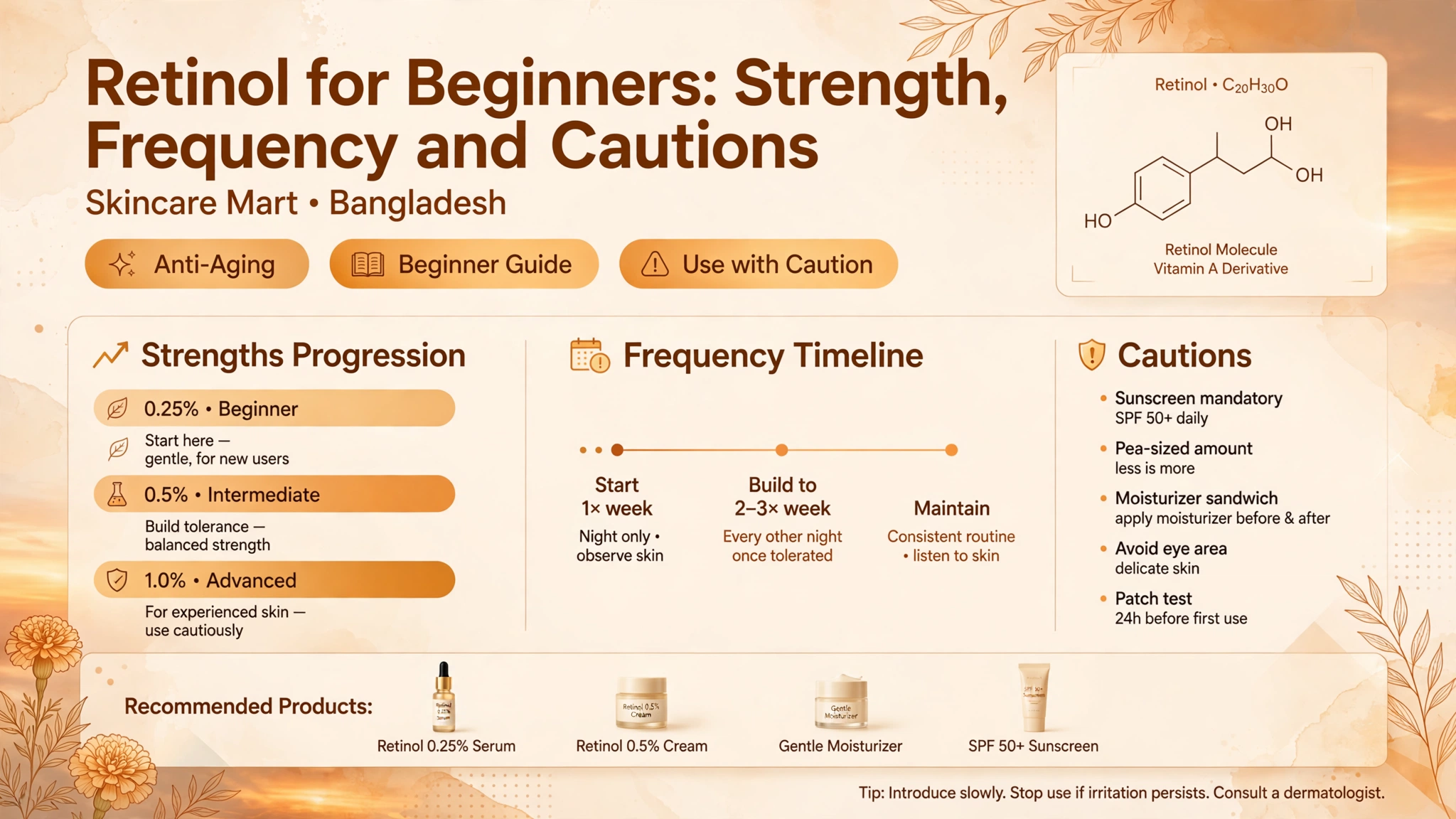
Retinol products commonly range from about 0.01% to 1%. For beginners, a low concentration — roughly 0.25% to 0.3% — is a widely recommended starting point, with some guidance suggesting starting even lower, around 0.1%, for very sensitive skin. A higher percentage is not automatically better and can cause more irritation without necessarily speeding up results — the strength that your skin can tolerate consistently outperforms a higher strength you can only use sporadically.
It's worth knowing where retinol sits in the broader retinoid family: retinol is an over-the-counter option that converts through a couple of steps to its active form in the skin, generally offering a moderate irritation risk; tretinoin (a prescription-only retinoid) is the most studied and most potent, converting more directly and carrying a higher irritation risk. Bakuchiol is sometimes suggested as a gentler, non-retinoid alternative for skin that doesn't tolerate retinol well, though its evidence base is generally considered less extensive.
How often to use it: a beginner build-up
A commonly recommended gradual schedule looks like this:
- Weeks 1–2: Two non-consecutive nights a week (for example, Tuesday and Saturday).
- Week 3: Add a third night if skin is comfortable.
- Week 4: Move to every other night if there's no persistent dryness or irritation.
- Weeks 5–6 onward: Some people move to nightly use; many get excellent long-term results staying at every-other-night indefinitely. There's no added benefit to using it more often than your skin comfortably allows.
Apply a pea-sized amount for the whole face — more product doesn't improve results and increases irritation risk. If skin feels sensitive, the "sandwich method" — a thin layer of moisturizer, then retinol, then another layer of moisturizer — can buffer the intensity while you build tolerance.
Understanding purging versus a bad reaction
Many beginners experience some dryness, redness, or flaking in the first couple of weeks, sometimes called "retinisation" or the retinol "purge" — retinol speeds up cell turnover, which can temporarily bring existing congestion to the surface before skin clears. This is generally described as a temporary phase that improves with continued, appropriately paced use, typically resolving within about eight weeks. It's different from a genuine adverse reaction: purging tends to show up where you'd normally break out and gradually improves, while a true reaction often shows up as a new pattern of bumps, itching, or redness in unusual areas and doesn't resolve on its own — that's a signal to pause and consult a dermatologist rather than push through.
Bangladesh climate context
Retinol's sun-sensitizing effect matters more in Bangladesh's climate than in a lower-UV environment, given the country's high year-round sun exposure — daily broad-spectrum SPF 30+ is non-negotiable while using retinol here, not optional. Heat and humidity can also make the skin barrier feel more sensitive to a new active during the adjustment period for some people, so starting conservatively and watching how skin responds over the first few weeks is worth taking seriously, particularly during the hotter months.
How to use retinol correctly
| Step | What to do |
|---|---|
| Timing | Night only — retinol breaks down in sunlight and increases photosensitivity |
| Amount | A pea-sized amount for the entire face |
| Order | Applied after cleansing, on dry skin, before moisturizer |
| Frequency | Start two nights a week; increase gradually over 8–12 weeks |
| Next morning | Broad-spectrum SPF 30 or higher, without exception |
Managing irritation without quitting
If skin flakes or feels tight, the usual advice is not to stop entirely but to skip a night or two, add extra moisturizer, and consider the sandwich method to reduce intensity without abandoning the routine. If irritation lasts more than a week, or skin becomes noticeably red and painful, pausing retinol for about ten days, focusing on barrier repair with a ceramide-rich moisturizer, and restarting at half the previous frequency is a reasonable reset. Avoid layering other potentially irritating ingredients — strong exfoliating acids, alcohol-heavy toners — on the same nights you use retinol.
Mistakes and cautions
- Applying nightly from day one. This is the most common starting mistake and the most common reason people quit retinol before giving it a fair chance.
- Skipping sunscreen the next morning. Retinol increases sun sensitivity, and skipping SPF undoes much of the benefit while raising the risk of sun damage.
- Using retinol during pregnancy or while breastfeeding without medical guidance. Topical retinol's risk during pregnancy isn't as clearly established as with oral retinoids, but the general, cautious recommendation is to avoid all retinoids during pregnancy and use them carefully, under guidance, while breastfeeding.
- Confusing a genuine reaction for purging. Purging resolves with continued, paced use; a true reaction — new bumps in unusual areas, persistent itching — needs a pause and, if it continues, a dermatologist's input.
- Layering retinol with other strong actives too soon. Combining it with strong exfoliating acids or benzoyl peroxide before your skin has built tolerance significantly raises irritation risk.
Frequently asked questions
What percentage of retinol should I start with?
Around 0.25% to 0.3% is a commonly recommended starting point for most beginners, with some guidance suggesting starting even lower — around 0.1% — for very sensitive skin.
How often should I use retinol when I'm just starting out?
Two non-consecutive nights a week for the first couple of weeks, gradually increasing frequency over 8 to 12 weeks as your skin shows it tolerates the ingredient.
Is retinol safe to use during pregnancy?
The general, cautious recommendation is to avoid retinol and other retinoids during pregnancy, and to use them carefully under a clinician's guidance while breastfeeding. This is worth a direct conversation with your doctor rather than general skincare advice.
What's the difference between purging and a bad reaction?
Purging typically shows up where you normally break out and improves within four to six weeks with continued, paced use. A genuine reaction shows up as new bumps in unusual areas, often with itching or redness, and doesn't resolve on its own — that's a signal to pause and reassess, not push through.
Do I need to wear sunscreen if I only use retinol at night?
Yes. Retinol increases skin's sensitivity to UV exposure through the following day, regardless of when you apply it, so daily broad-spectrum sunscreen is essential while using it.
How long before I see results from retinol?
Twelve weeks is a reasonable point to expect visible changes in texture and tone, with the fuller, compounding benefits typically building over closer to twelve months of consistent use.
Getting started
Retinol rewards patience: a low starting strength, a slow frequency build-up, and consistent sunscreen the next morning matter more than jumping to a high percentage. Browse Skincare Mart's serum category for beginner-strength retinol options, and check each product's concentration and usage instructions on its page before starting your first routine.