
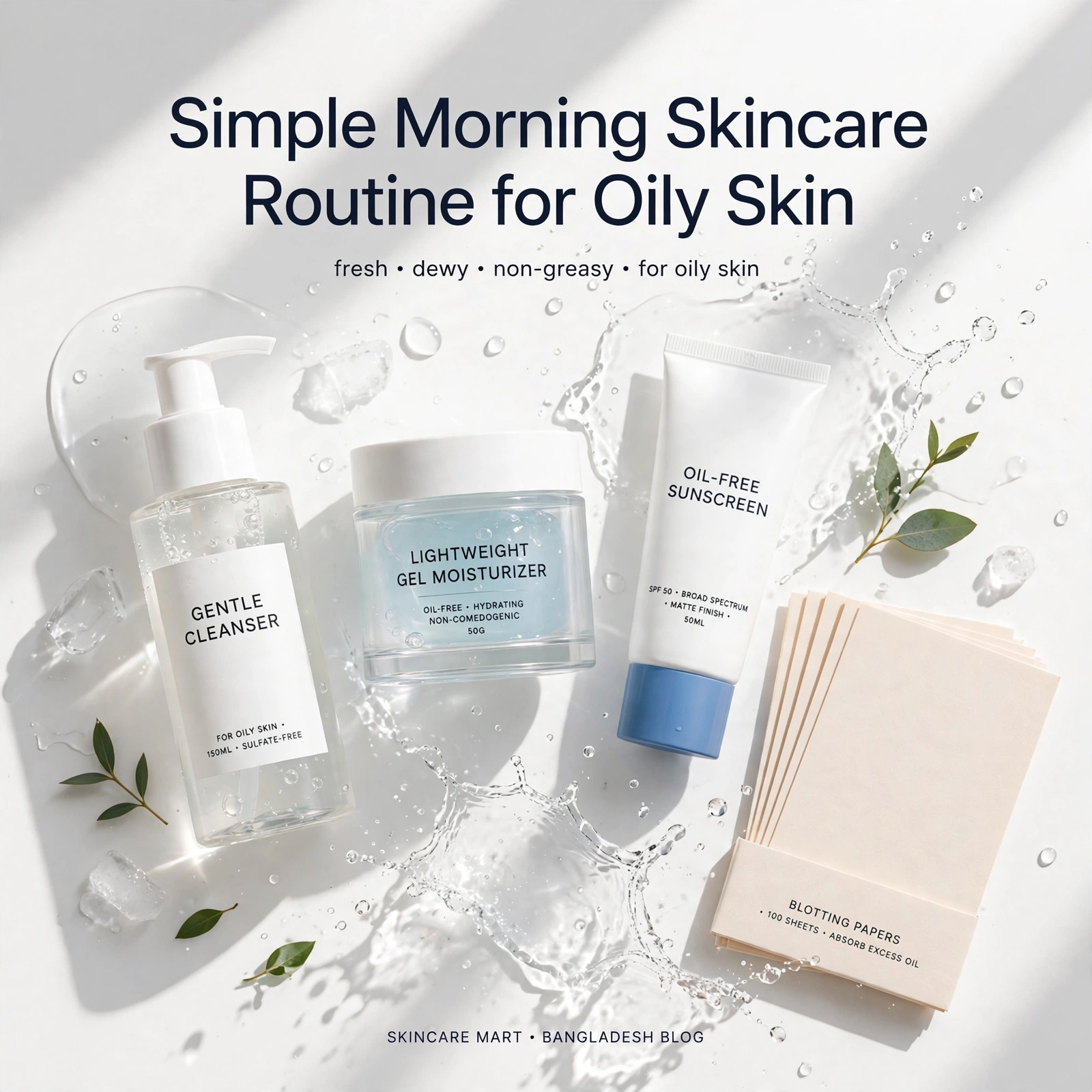
If your face looks fine at 8am and shiny by 10, you're dealing with one of the most common — and most manageable — skin types. Oily skin isn't a flaw to fix; it's a skin type to work with, and the right morning routine can cut the shine without stripping your skin or triggering more oil.
Quick answer: A simple morning routine for oily skin has four steps: a gentle, oil-free foaming or gel cleanser; an optional lightweight treatment; an oil-free, noncomedogenic moisturizer (yes, even oily skin needs one); and a broad-spectrum SPF 30+ sunscreen, ideally one labeled non-comedogenic or matte-finish. Skip harsh, stripping cleansers and skipping moisturizer altogether — both tend to backfire by making skin produce more oil, not less.
Who this guide is for
This is a general-purpose morning routine for people whose skin tends to look shiny, especially in the T-zone, by mid-morning. It's a starting point, not a treatment plan for diagnosed acne, rosacea, or other skin conditions — if breakouts are persistent, painful, or leaving scars, or if you're managing a known skin condition, a dermatologist can tailor a routine and, where needed, prescribe treatment. This routine also isn't a claim that any product cures oiliness permanently; oil production is largely genetic and hormonal, and skincare manages it rather than switching it off.
Why oily skin needs a moisturizer too
The instinct to skip moisturizer because skin already feels greasy is understandable, but dermatologists specifically flag it as a mistake. The American Academy of Dermatology's guidance on oily skin recommends applying moisturizer daily regardless of oiliness, and warns that products labeled "oil-free" and "noncomedogenic" are formulated specifically so they won't clog pores or worsen breakouts. Skipping moisture, or over-washing with harsh cleansers to feel "squeaky clean," can actually push skin to produce more oil to compensate — the opposite of the intended effect.
The 4-step morning routine
- Cleanse: A gentle, foaming or gel cleanser, used once or twice daily and after sweating. Avoid scrubbing — dermatology guidance is clear that scrubbing, even to remove makeup, irritates skin and can make oiliness and breakouts worse rather than better.
- Treat (optional): If you use a targeted product — niacinamide is a common choice for oil and pore appearance — apply it after cleansing, on clean, dry skin, before moisturizer.
- Moisturize: An oil-free, noncomedogenic lotion or gel moisturizer. Lightweight formulas absorb faster and feel less heavy under makeup or through a humid morning.
- Protect: A broad-spectrum sunscreen, SPF 30 or higher. Look specifically for sunscreens labeled oil-free, noncomedogenic, or containing zinc oxide or titanium dioxide, since fragranced or oil-based sunscreens are more likely to trigger breakouts on oily, acne-prone skin.
That's the complete routine — four steps, no double-cleansing required in the morning (that's more useful at night, to remove the day's sunscreen and oil buildup), and no ten-product shelf needed to see results.
Bangladesh climate context
Heat and humidity make oily skin oilier for most of the year here, and the effect intensifies during monsoon season, when a Dhaka-based dermatologist has noted that increased humidity drives up sebaceous gland activity and skin appears visibly shinier. That makes the "don't skip moisturizer, don't over-cleanse" advice above even more relevant locally — the temptation to wash more often or use a stronger cleanser is strongest exactly when it's most likely to backfire. Choosing genuinely lightweight, gel-based textures for both moisturizer and sunscreen matters more in Dhaka's climate than it would somewhere drier and cooler.
Product-selection checklist
| Step | Look for | Avoid |
|---|---|---|
| Cleanser | Gentle foaming or gel formula, labeled for oily or combination skin | Alcohol-based or oil-based cleansers, harsh scrubs |
| Treatment | Niacinamide or a mild exfoliating acid, used a few times a week to start | Multiple active ingredients layered at once as a beginner |
| Moisturizer | Labeled "oil-free" and "noncomedogenic," gel or lightweight lotion texture | Heavy creams or balms as your only daytime moisturizer |
| Sunscreen | Broad-spectrum SPF 30+, oil-free or matte-finish, mineral options with zinc oxide/titanium dioxide | Fragranced or heavily oil-based sunscreens |
How to introduce this routine and use it correctly
Apply sunscreen to dry skin about 15 minutes before heading outdoors, and plan to reapply roughly every two hours if you're outside for extended periods, or after heavy sweating — a real consideration during Bangladesh's hot months, since sweat can shorten how long a morning application actually protects you. If you're adding a treatment step like niacinamide for the first time, patch-test it on a small area for 24 to 48 hours, then introduce it a few times a week before daily use, watching for irritation. Apply products from thinnest to thickest texture: any treatment first, moisturizer next, sunscreen last.
Mistakes and cautions
- Skipping moisturizer because skin feels oily. This is the single most common misstep and tends to worsen oiliness over time rather than reduce it.
- Over-washing or scrubbing. Washing more than twice a day, or scrubbing hard, strips the skin barrier and can trigger more oil production, not less.
- Choosing a heavy, fragranced sunscreen. These are more likely to clog pores on oily, acne-prone skin than an oil-free or mineral formula.
- Blotting instead of treating the cause. Blotting papers can help manage midday shine, but should be pressed gently rather than rubbed, since rubbing spreads oil rather than removing it.
- Stacking too many actives at once. Introducing niacinamide, exfoliating acids, and retinol simultaneously makes it hard to tell what's helping or irritating your skin.
Frequently asked questions
Should I really moisturize if my skin already looks shiny by noon?
Yes. Dermatology guidance recommends daily moisturizer for oily skin specifically because skipping it can push skin to produce more oil to compensate for lost hydration.
Is a foaming cleanser too harsh for oily skin?
A gentle foaming or gel cleanser is generally recommended for oily skin — the concern is choosing one that's too strong or alcohol-based, not foaming cleansers as a category. If your skin feels tight or irritated after washing, the cleanser may be too harsh and worth switching.
Can I skip sunscreen if I'm wearing a moisturizer with SPF?
A moisturizer with built-in SPF can work as your daytime sunscreen if it's broad-spectrum SPF 30 or higher, but it still needs reapplying roughly every two hours if you're outdoors for a while — the SPF wears off the same way a standalone sunscreen's does.
Will this routine get rid of my oily skin permanently?
No skincare routine changes how much oil your skin naturally produces long-term; oiliness is largely genetic and hormonal. A consistent routine manages shine and reduces breakout risk, but it isn't a cure, and persistent or severe oiliness with breakouts is worth discussing with a dermatologist.
How often should I exfoliate if I have oily skin?
Occasional exfoliation, rather than daily, is generally advised for oily skin — a few times a week is a reasonable starting point, followed by moisturizer, with frequency adjusted based on how your skin responds.
Do I need a different routine at night?
Evenings are a good time to remove the day's sunscreen and oil buildup, which is why a double cleanse (an oil or micellar cleanse followed by your regular cleanser) is more useful at night than in the morning. The moisturizing step stays the same; sunscreen is dropped after dark.
Getting started
Oily skin responds well to a routine that's consistent rather than complicated: a gentle cleanser, a lightweight oil-free moisturizer, and daily sunscreen cover the essentials, with any treatment step added gradually. Browse Skincare Mart's cleanser, moisturizer, and sunscreen categories for oil-free and noncomedogenic options, and check each product page for the current ingredient list before adding something new to your routine.